IPC Class
|
What is IPC Class? - IPC Class Meaning
IPC Class Requirements in PCB Production1.Acquire final product control of high quality and reliability. 2.Improve communication with many employees and suppliers. 3.Reduce the cost of PCB. 4.Raise your reputation and create new opportunities. To effectively apply IPC's PCB Classes, a clear understanding of its standardized terminology is essential for proper communication and course enrollment. Key terms defined in the IPC Classes encompass: 1.Acceptance Testing: Verification that a product meets the specific criteria set by the PCB customer, buyer, or supplier.2.Assembly: The process of fitting, joining, or mounting various components to create a complete unit or sub-assembly. 3.Anti-Corrosive Coating: A protective layer applied to preserve the base material during manufacturing stages like plating, etching, or soldering. 4.Integrated Circuit (IC): A miniaturized electronic network fabricated on a semiconductor material to perform a specific function. 5.Flexural Endurance: The ability of a material to withstand repeated bending, folding, or twisting without failure. 6.Critical Process: A defined operation or procedure that directly affects the final properties and performance of the product. The Three Primary IPC ClassesIPC Standards guide PCB development across design, fabrication, and assembly, ensuring quality and competitiveness at every phase. These sequential stages integrate relevant standards to meet final product specifications. The standards apply to three primary categories of printed circuit board-based electronic products.
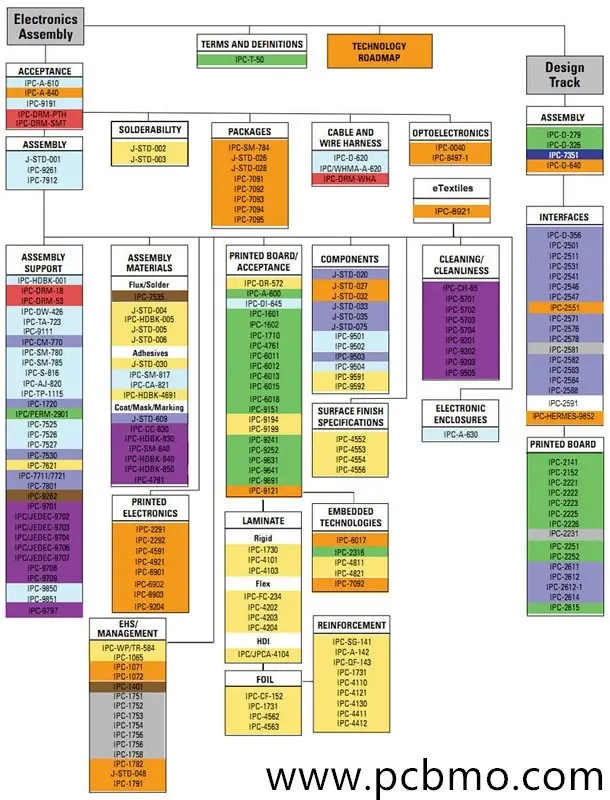
Key IPC Standards in PCB Fabrication and AssemblyIn PCB fabrication and assembly, key standards include:
Adherence to IPC standards is critical in producing high-quality printed circuit boards. Globally, IPC-J-STD-001G governs soldering materials and assembly methods. This standard also supports training and certification for electrical and electronic soldering in manufacturing. Today’s electronics sector relies on IPC guidelines to ensure process uniformity, product quality, and manufacturing efficiency. The IPC-7350 series, for example, guides the physical layout of various PCB types, helping optimize reliability, performance, lead time, cost, and material usage. During PCB design, correct component placement must be verified to avoid later redesign or specialized part costs. While IPC standards inform design decisions, CAD software is typically used for the actual PCB layout, component arrangement, and design strategy. In-Depth Look at IPC ClassesIPC Class 1: General Electronic ProductsIPC Class 1 defines general-use printed circuit boards intended for applications with limited life cycles and straightforward functionality. The primary focus is on ensuring basic operational capability of components. 1.Key Focus: Basic function.2.Appearance: Visual imperfections are acceptable provided they do not interfere with the board’s electrical performance. 3.Reliability: Not a critical consideration. 4.Examples: Television remote controls, LED lighting, and children's toys. These are the most cost-effective PCBs available, though they have a shorter expected service life. IPC Class 2: Dedicated Service Electronic ProductsIPC Class 2 applies to electronic products designed for extended durability, such as those used in televisions, computers, or air conditioners. These are products that require uninterrupted operation over a longer lifespan, though not under severe conditions. 1.Key Focus: Extended life and continuous performance.2.Appearance: Minor cosmetic flaws may still be permitted. 3.Reliability: Offers improved reliability and longevity over Class 1. 4.Performance: Must perform consistently in typical operating environments without failure. IPC Class 3: High-Performance Electronic ProductsIPC Class 3 is reserved for high-performance or mission-critical applications where operational downtime is unacceptable. These boards must function reliably under extreme environmental stresses and be ready for use at any time. 1.Key Focus: Uninterrupted, on-call performance.2.Manufacturing: Manufactured and tested according to the most rigorous criteria. 3.Reliability: Delivers the highest level of reliability. 4.Examples: Life-support systems, military equipment, automotive controls, and vital monitoring systems where failure is not an option. IPC-6012DS 3A ClassThis is a specific classification under IPC-6012, often denoting a higher level of performance or qualification for rigid printed boards. PCBMO's Commitment to IPC Standards
|