PCB vs. PCBA: Which Service Should I Order?
In electronics manufacturing, the terms PCB and PCBA are often used, but they represent distinct stages and products. Ordering the wrong service can lead to project delays, increased costs, and frustration. Understanding the fundamental difference between a PCB and a PCBA is crucial for a successful product launch. This guide will clarify these terms and help you decide which service is right for you.
What is a PCB?
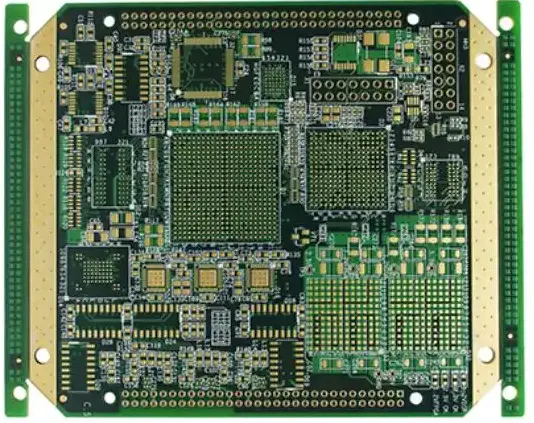
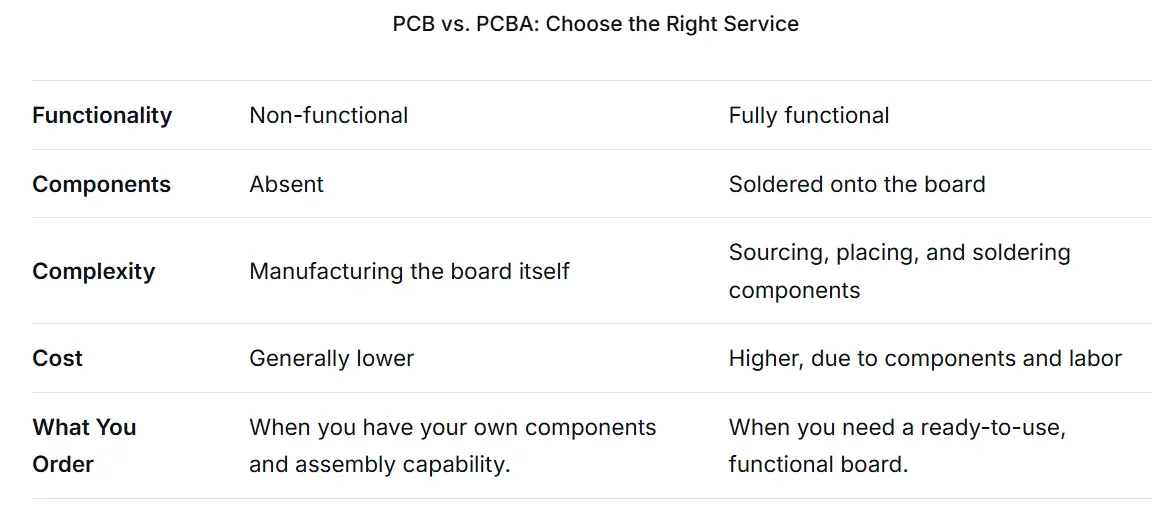
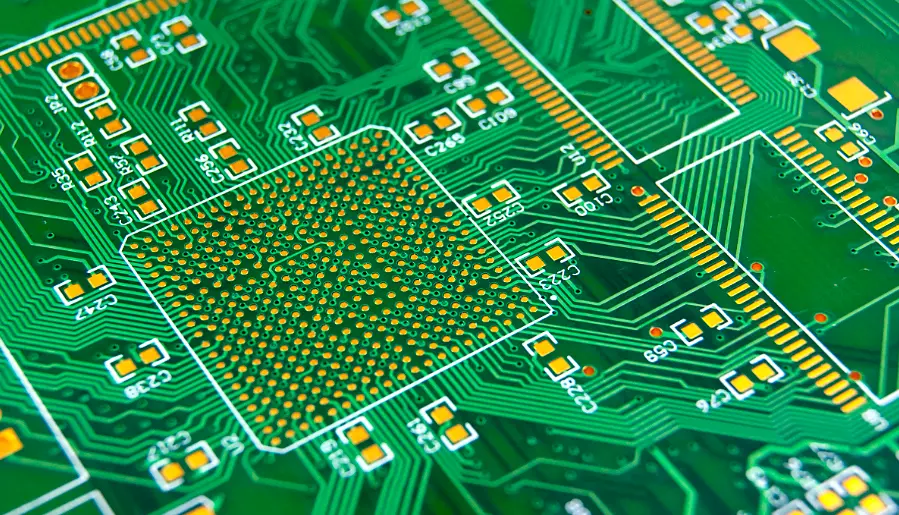
PCB (Printed Circuit Board) is the foundational physical platform for electronic components. It’s the bare, non-conductive board—typically green—with pre-etched copper traces that form the electrical pathways between points. Think of a PCB as the "skeleton" or "roadmap" of your electronic device. It provides the structure and connections but has no functionality on its own. Key Characteristics of a PCB: Made of laminate material like FR-4. Features copper traces, pads, and vias. No electronic components are attached. It is a component itself, not a finished product.
What is a PCBA?
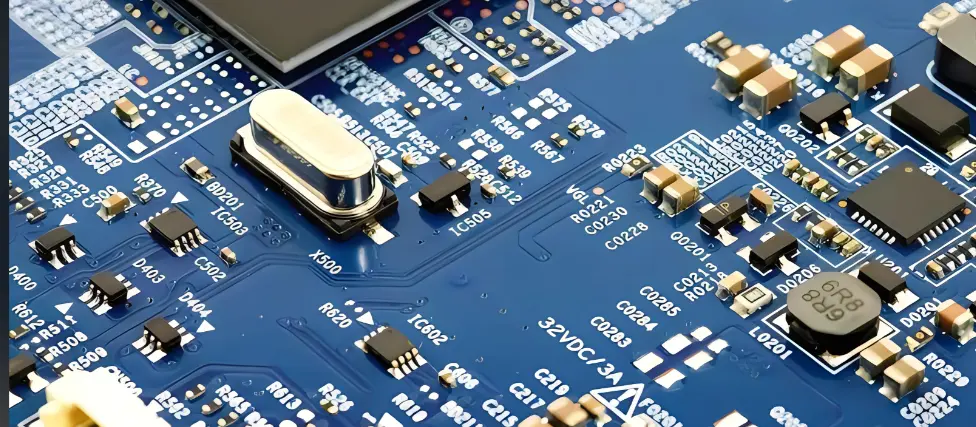
PCBA (Printed Circuit Board Assembly) is the next, more advanced stage. It refers to the same PCB after all the necessary electronic components (resistors, capacitors, integrated circuits, etc.) have been soldered onto it. This process, called assembly or population, transforms the inert board into a functional circuit. A PCBA is the "brain" of your device, ready to power its operations. Key Characteristics of a PCBA: A PCB that has been fully populated with components. The assembly process can be done by hand or with automated machinery (SMT and THT). It is a functional, tested electronic sub-assembly. Often involves sourcing all necessary components.
Which Service Should You Order?
Your choice depends entirely on your capabilities, project stage, and needs.
Order a PCB if:
1、You Handle Assembly In-House: Your company has the expertise, equipment, and supply chain to source and solder components yourself. 2、You Are a Hobbyist/Prototyper: You enjoy the hands-on work of soldering components for a one-off project. 3、You Only Need the Foundation: You are responsible for only the board fabrication, and a partner handles the assembly separately.
Order a PCBA if:
1、You Want a Turnkey Solution: This is the most common choice for businesses and developers. You want a fully functional, tested board delivered to your door, ready for integration into your product. 2、You Lack Sourcing/Assembly Resources: Managing a global supply chain for tiny components requires significant effort. A PCBA provider handles this for you. 3、You Need Quality and Speed: Professional assembly ensures high-quality, reliable solder joints and faster time-to-market, especially for complex or volume production. 4、You are Developing a New Product: From prototyping to mass production, a PCBA service simplifies the entire process under one roof.
Conclusion
In short: order the PCB for the physical board alone. Order the PCBA for a complete, working circuit board. For most businesses and product developers, PCBA is the recommended service. It reduces complexity, ensures quality, and accelerates development, allowing you to focus on your core product rather than the intricacies of component sourcing and assembly. Always clarify this distinction with your manufacturer to ensure you receive exactly what your project requires.
What Is the Role of AI and IoT in the Smart Manufacturing Process?
The term "Smart Manufacturing" is synonymous with Industry 4.0, representing a seismic shift from traditional production to a fully connected, automated, and intelligent ecosystem. At the heart of this revolution are two transformative technologies: the Internet of Things (IoT) and Artificial Intelligence (AI). But what is their specific role, and how do they work together to create a superior manufacturing process? This article breaks down the synergistic partnership of AI and IoT that is powering the factories of the future.

IoT: The Nervous System of the Smart Factory
The Internet of Things provides the critical layer of connectivity. It involves embedding sensors into machinery, production equipment, and even products themselves. These sensors act as the factory's "nerve endings," constantly collecting real-time data on everything from machine temperature and vibration to energy consumption and production line speed. In essence, IoT's role is to make the invisible, visible. It provides a massive, continuous stream of data on the physical state of the manufacturing process, creating a digital twin of the entire operation.
AI: The Brain That Makes Decisions
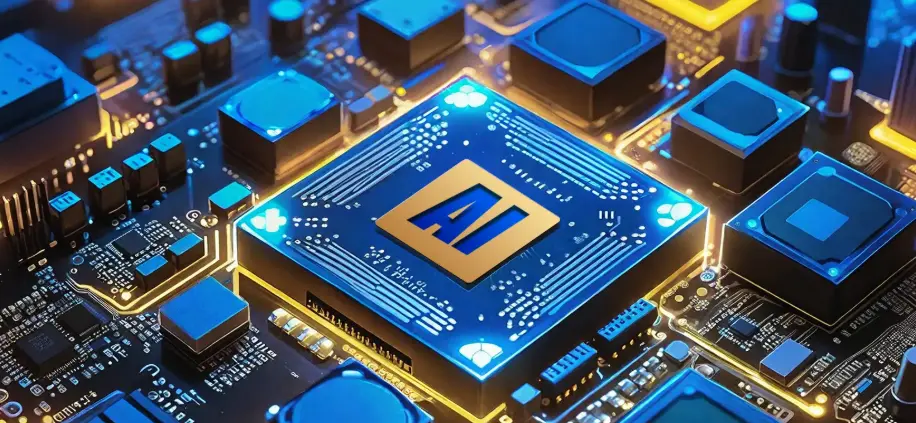
While IoT collects the data, Artificial Intelligence is the "brain" that analyzes it and generates insights. The massive datasets from IoT sensors would be overwhelming for human analysis. AI and its subfield, Machine Learning (ML), step in to identify patterns, predict outcomes, and make intelligent decisions. AI transforms raw data into actionable intelligence, enabling a proactive and self-optimizing manufacturing environment.
The Powerful Synergy in Action: Key Use Cases
The true magic happens when IoT and AI converge. Here’s how they collaborate to enhance the manufacturing process: 1、Predictive Maintenance: This is a flagship application. IoT sensors monitor equipment for subtle changes (e.g., unusual vibrations, heat spikes). AI algorithms analyze this data to predict a potential failure before it happens. This allows maintenance to be scheduled just in time, preventing costly unplanned downtime and extending asset life. 2、Enhanced Quality Control: IoT cameras on the production line capture high-resolution images of products. AI-powered computer vision systems inspect these images in real-time, identifying microscopic defects that are invisible to the human eye. This drastically improves product quality and reduces waste. 3、Optimized Supply Chain and Logistics: IoT trackers monitor the location and condition of raw materials and finished goods in transit. AI uses this data, along with historical trends and weather information, to forecast demand, optimize inventory levels, and suggest the most efficient delivery routes. 4、Energy Management: IoT sensors monitor energy consumption across the factory floor. AI analyzes this data to identify waste patterns and can automatically adjust non-essential machinery or HVAC settings to minimize energy usage, leading to significant cost savings and a smaller carbon footprint.
The Future is an Integrated, Self-Learning System
The role of AI and IoT in the smart manufacturing process is not just to automate, but to cognify. They are creating manufacturing systems that are not only connected but also cognitive—capable of learning from data, adapting to changes, and continuously self-optimizing for peak efficiency, quality, and flexibility. For any modern manufacturer, integrating this powerful duo is no longer a luxury but a necessity to remain competitive in the global market.
How Do You Compare Pricing Models for Quality Assurance and Testing Services?
Selecting the right Quality Assurance (QA) and testing partner is a critical decision for any business. However, before you even evaluate a vendor's expertise, you're faced with a fundamental question: which pricing model makes the most financial and strategic sense for your project? Understanding and comparing the common pricing structures is the first step to making an informed procurement decision. Here’s a clear breakdown of the three primary models.
1. Fixed-Price Model
In this model, you agree on a set scope of work, a defined timeline, and a single, fixed cost with the vendor. Best For: Projects with well-documented, unchanging requirements. Think of a short-term project with a clear set of test cases or a specific milestone like final User Acceptance Testing (UAT). Pros: Budget Certainty: Costs are predictable, making it easy to manage finances. Low Oversight: Requires minimal management once the contract is signed. Cons: Inflexibility: Any change in scope can lead to costly renegotiations. Vendor Risk: The vendor may cut corners to meet the fixed budget, potentially compromising quality.
2. Time and Materials (T&M) Model
You pay based on the actual time (e.g., per hour, per day) the QA resources spend on your project, plus any material costs. Best For: Projects with evolving requirements, agile development cycles, or when the full scope is unknown at the outset. Pros: High Flexibility: Easily adapt to changing priorities and new features. Transparency: You see exactly where the effort is going, often with detailed timesheets. Cons: Budget Uncertainty: The final cost can be unpredictable if not managed closely. Requires Active Management: You need a dedicated project manager to monitor hours and ensure efficiency.
3. Dedicated Team Model
You essentially "hire" a full-time, remote team of testers (e.g., a QA Lead, Automation Engineer, and Manual Testers) from the vendor for a monthly fee. Best For: Long-term projects, ongoing product development, or when you need deep integration of the QA team into your own processes. Pros: Team Integration: The team becomes an extension of your own, deeply understanding your product. Scalability: You can scale the team up or down based on your needs. Full Control: You manage the team's priorities and daily tasks directly. Cons: Highest Commitment: Requires a significant and ongoing financial commitment. Recruitment Responsibility: You are involved in selecting the team members.
How to Make the Final Comparison
To choose the best model, ask yourself these key questions: Is my project scope clearly defined and fixed? If yes, Fixed-Price may work. If no, lean towards T&M or a Dedicated Team. What is my project's timeline? Short-term projects suit Fixed-Price or T&M, while long-term partnerships align with the Dedicated Team model. How much control and oversight can I provide? If you have limited management bandwidth, Fixed-Price is simplest. For hands-on control, choose T&M or a Dedicated Team.
There is no one-size-fits-all answer. The most effective procurement strategy involves matching the pricing model not just to your project's requirements, but also to your company's capacity for management and tolerance for financial risk. By making this careful comparison, you secure not just a service, but a valuable partnership.