Panasonic MEGTRON6(M6) R-5775 & R-5670 Datasheet
Panasonic R-5775 MEGTRON6 (M6) is a high-performance laminate material designed for demanding circuit board applications, featuring minimal signal loss and superior thermal durability.
This product series comprises variations such as MEGTRON 6 (N), (G), (K), and the base MEGTRON 6. It utilizes low-Dk glass reinforcement in the 5775 (N) laminate and R-5670 (N) prepreg, alongside the standard E-glass based 5775 laminate and R-5670 prepreg.
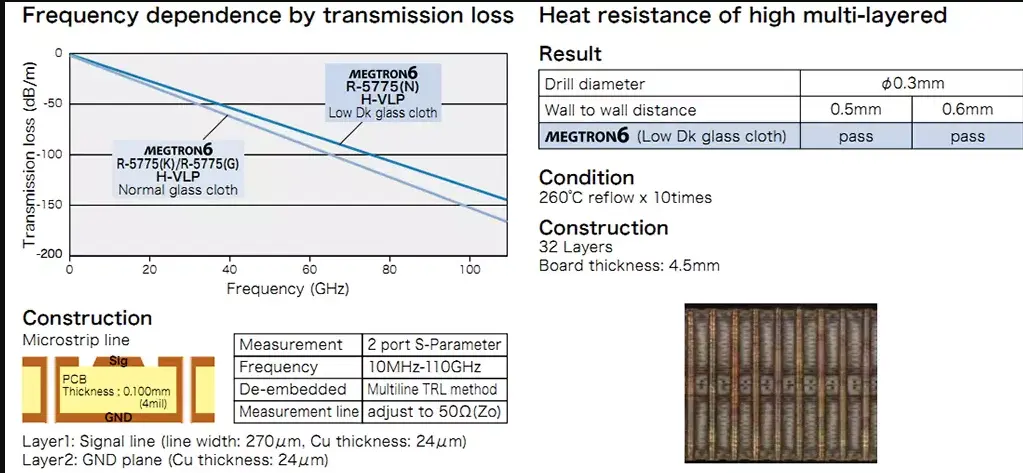
MEGTRON6 (M6) is a widely adopted substrate composed of glass fiber-reinforced epoxy. It delivers strong mechanical strength, electrical performance, and thermal stability, making it ideal for high-speed, ultra-low loss circuits in mobile, networking, and wireless applications.
The MEGTRON6 R-5775 variant employs polyphenylene ether (PPE) as its base resin, providing a low dielectric constant and minimal dissipation factor (Dk=3.34, Df=0.002 at 1GHz). Combined with high-frequency very-low profile copper foil (H-VLP), the material achieves transmission loss levels comparable to PTFE-based substrates.
Fabrication processes for MEGTRON6 R-5775 align with standard FR-4 procedures, eliminating the need for specialized through-hole plating preparation such as plasma treatment. It is also compatible with solder mask grinding operations.
With a Z-axis CTE of 45ppm/°C, MEGTRON6 R-5775 ensures reliable plated through-hole integrity. It features a high glass transition temperature (Tg 185°C), meets lead-free soldering standards, and exhibits low moisture absorption, high strength, and excellent dimensional stability.
For high-speed PCB design, the precision and performance demands continue to grow. Panasonic's M6 materials, particularly the R-5775 (N) and R-5670 (N) grades, create new possibilities for developing and prototyping high-speed boards, supporting complex layouts while maintaining stable high-frequency performance.
Implementing M6 enables PCB designers to achieve denser, higher-performance layouts. Key benefits include:
Enhanced Signal Integrity: The low Dk/Df properties of R-5775 (N) and R-5670 (N) help minimize signal delay and boost circuit efficiency.
Greater Design Flexibility: Advanced multilayer construction allows for sophisticated circuit integration within compact spaces.
Faster Time-to-Market: The streamlined design and prototyping process with Panasonic M6 technology shortens development cycles from concept to prototype.
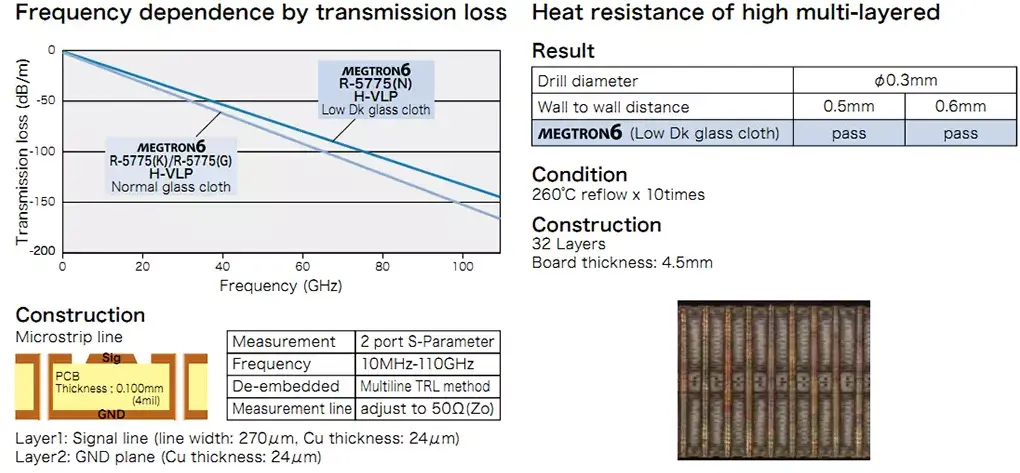
MEGTRON6 Datasheet
For the prototyping phase of advanced multilayer PCBs, R-5775 (N) and R-5670 (N) substrates prove highly effective. They contribute to increased production yields and shorten the sampling timeline by minimizing the need for repeated design adjustments. Furthermore, the superior manufacturability of MEGTRON6 (M6) ensures that these high-performance standards are consistently met in volume manufacturing, thereby enhancing the final product's quality and reliability.
The integration of M6's precise engineering with the specific attributes of R-5775 (N) and R-5670 (N) enables the development of sophisticated, high-layer-count, high-speed PCBs to remain at the technological forefront. This progress is crucial not just for fabricators but also for enterprises operating in high-performance computing, advanced telecommunications, and precision instrumentation, where such boards are essential.
The application of Panasonic's M6 technology within the R-5775 (N) and R-5670 (N) framework delivers exceptional efficiency and performance for creating complex, high-speed multilayer prototypes. As the demand for greater speed and complexity in electronics continues to grow, this synergistic technological approach establishes a robust platform for ongoing innovation.