Rogers Cuclad Laminates: CuClad 217, 233, 250 Technical Data
For PCB designers and manufacturers navigating the critical demands of high-frequency circuits, the selection of the appropriate laminate is paramount. The Rogers Cuclad series, encompassing grades such as 217, 233, and 250, represents a class of polytetrafluoroethylene (PTFE) composites engineered to deliver consistent dielectric performance and mechanical stability. This technical overview delineates the key characteristics and comparative advantages of these three laminates, providing essential data to guide material selection for applications ranging from aerospace radar to automotive sensors and telecommunications infrastructure.
Comparative Technical Profiles:
1. CuClad 217: The Balanced High-Performer
CuClad 217 is formulated with a woven glass microfiber reinforcement within a PTFE matrix. This structure achieves an optimal balance of mechanical durability and electrical properties.
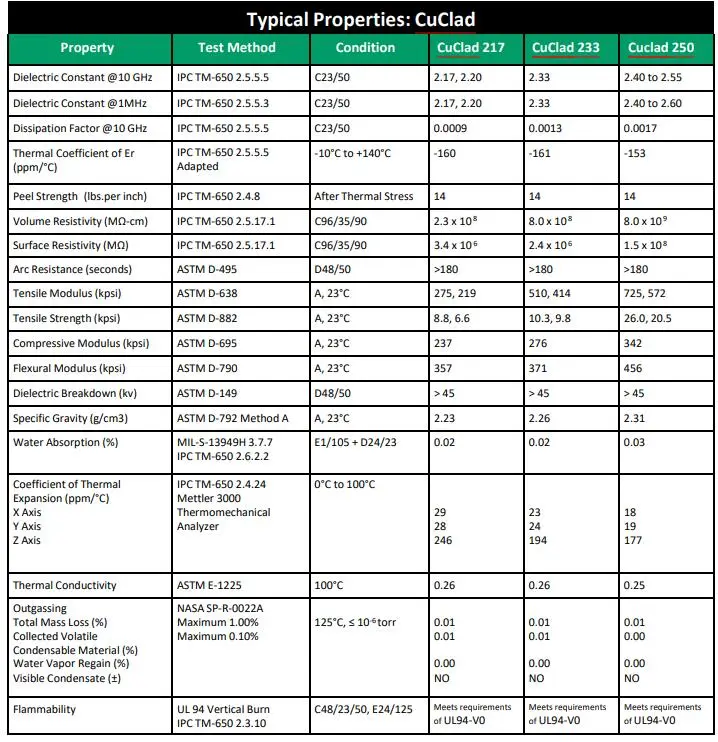
Dielectric Constant: Exhibits a stable dielectric constant (Dk) of 2.17, which is consistent across a wide frequency band. This low Dk is instrumental in achieving high signal propagation speeds.
Dissipation Factor: Features an exceptionally low dissipation factor (Df) of 0.0009, minimizing signal loss and making it suitable for high-performance transmission lines.
Primary Application Context: Its balanced properties render it ideal for precision components like filters, couplers, and low-loss substrates in commercial wireless systems.
2. CuClad 233: The Robust, Dimensionality-Stable Option
This laminate distinguishes itself with a heavier woven glass reinforcement, prioritizing mechanical ruggedness and dimensional integrity for complex multilayer boards.
Dielectric Constant: Possesses a slightly higher Dk of 2.33, a direct result of its increased glass content, which offers predictable performance.
Dissipation Factor: Maintains a very low loss tangent of 0.0015, ensuring good signal integrity even with the enhanced mechanical strength.
Primary Application Context: Its robustness is critical for demanding environments, including military/aerospace electronics, critical infrastructure, and multilayer PCB architectures where dimensional stability under thermal stress is non-negotiable.
3. CuClad 250: The Ultra-Low Loss Specialist
Engineered with a proprietary random glass microfiber structure, CuClad 250 is optimized for achieving the lowest possible signal attenuation.
Dielectric Constant: Offers a mid-range Dk of 2.50, providing a good compromise between circuit size and electrical performance.
Dissipation Factor: Boasts the lowest dissipation factor in this group, at 0.0005, establishing it as the premier choice for applications where minimizing signal loss is the paramount design criterion.
Primary Application Context: Essential for the most sensitive front-end circuits, including satellite communications (Satcom), point-to-point radio, and advanced radar systems.
CTFE thermoplastic copolymer adhesive film
CuClad 217, CuClad 233, and CuClad 250 are high-frequency circuit substrates composed of woven glass fabric and polytetrafluoroethylene (PTFE). By carefully adjusting the ratio of glass fiber to PTFE film, the series offers a selection of substrates ranging from ultra-low dielectric constant and loss tangent variants to mechanically robust types with enhanced dimensional stability.
Compared to non-woven glass-PTFE composites of similar permittivity, the woven glass construction in CuClad products delivers superior dimensional stability. Rogers-Arlon’s controlled manufacturing of PTFE-coated glass fabrics allows diverse dielectric constructions and ensures more consistent dielectric constant uniformity than non-woven alternatives. These stable electrical characteristics make CuClad suitable for filters, couplers, and low-noise amplifiers.
Rogers' CuClad Series, including models 217, 233, and 250, represents a line of high-frequency microwave circuit substrates. These materials are engineered from woven glass fiber reinforced with PTFE, designed specifically for advanced radio frequency applications.
The CuClad laminates are specified across a diverse range of industries and technologies. Key application areas encompass transportation systems such as rail and electric vehicles, industrial systems including automation, servo drives, and renewable energy infrastructure, and defense electronics for radar and countermeasure systems. They are also utilized in telecommunications for vehicle-to-everything (V2X) connectivity, base stations, and essential microwave components like low-noise amplifiers, filters, and couplers. Additional uses span consumer electronics, the Internet of Things (IoT), power conversion equipment, and various control systems.