What are the challenges of using THT in modern designs?
Through-Hole Technology (THT) has long been a cornerstone of electronic manufacturing, valued for its mechanical robustness and thermal conductivity in high-power applications. However, as modern electronic designs trend toward miniaturization, high density, and automation, THT faces mounting challenges that limit its applicability in many cutting-edge PCB design projects. This article explores the key hurdles of integrating THT into contemporary electronic systems, aligning with industry standards and practical manufacturing realities.
Density Limitations and PCB Real Estate Constraints
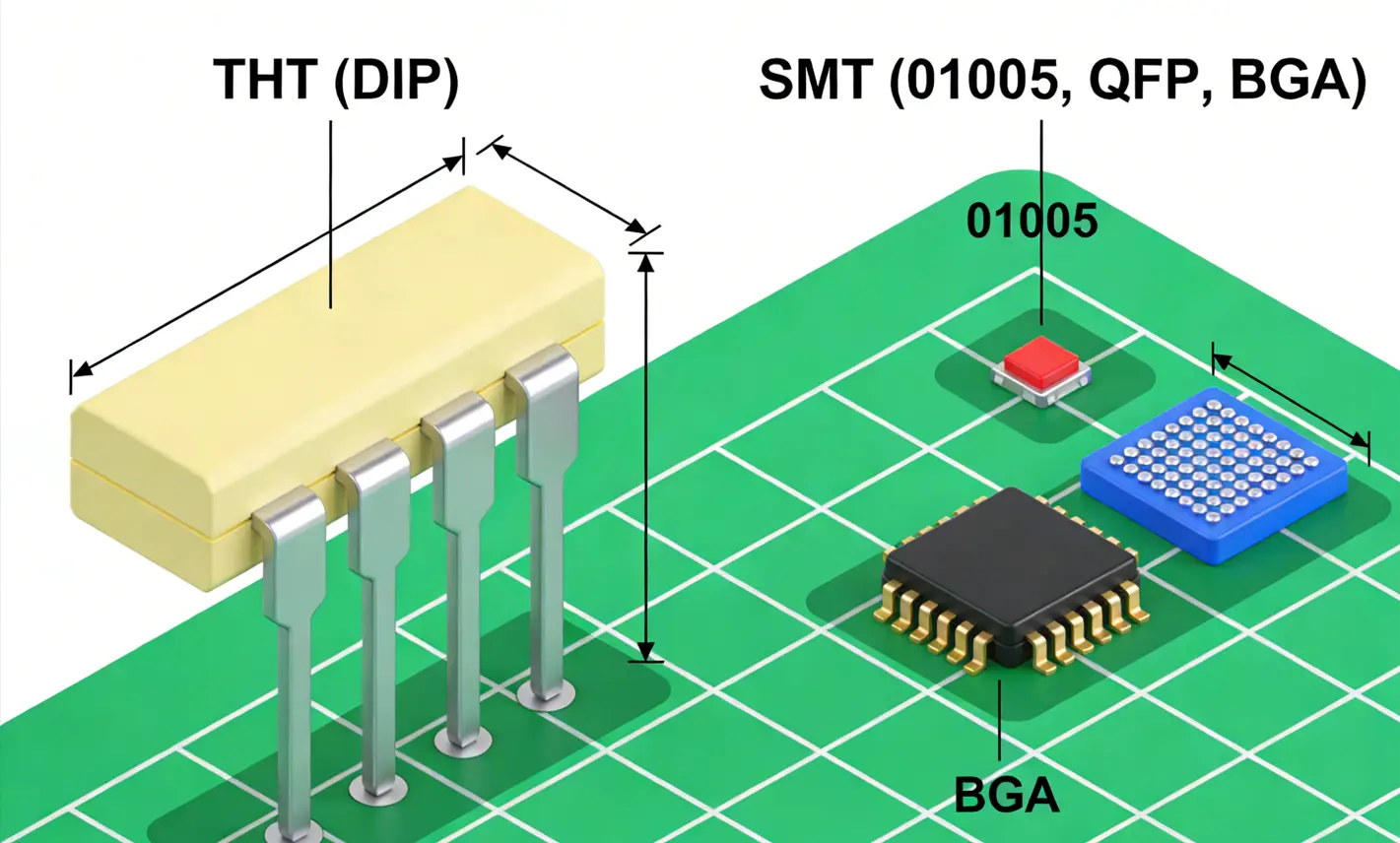
One of the most prominent challenges of THT in modern designs is its incompatibility with high-density PCB layouts. Unlike Surface Mount Technology (SMT) components, which are mounted directly on the PCB surface with minimal footprint, THT components require drilled holes for pin insertion, occupying significant board space. The standard 2.54mm pin pitch of common THT packages (such as DIP) is far larger than the sub-1mm pitches of SMD packages like QFP or BGA, reducing the number of components that can be placed per unit area.
This limitation is critical in consumer electronics (e.g., smartphones, wearables) and compact industrial modules, where miniaturization is a primary design goal. SMD components like 01005-sized passives occupy only 10% of the board space of equivalent THT parts, making THT impractical for devices requiring high component density. Additionally, THT holes disrupt signal layers and power planes in multi-layer PCB designs, complicating stack-up planning and reducing routing flexibility.
Production Efficiency and Automation Barriers
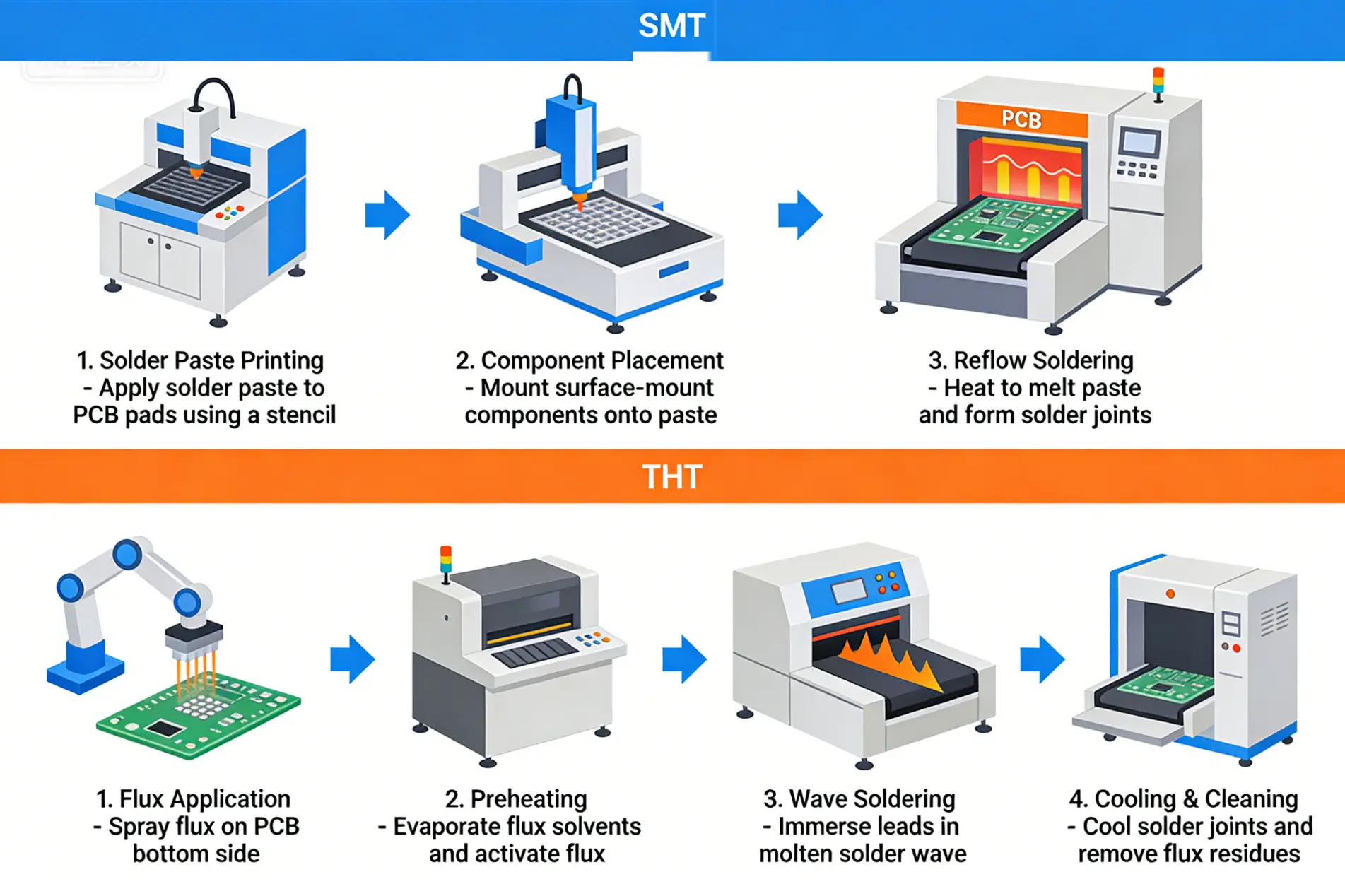
Modern PCB manufacturing relies heavily on automated processes to achieve high throughput and low defect rates, a paradigm where THT struggles to compete. SMT production lines use high-speed placement machines that can mount thousands of components per hour with precision, while THT assembly often requires manual insertion or semi-automated equipment for pin alignment.
The wave soldering process required for THT further slows production compared to SMT’s reflow soldering. Wave soldering involves additional steps such as stencil preparation for solder paste and post-welding cleanup, increasing cycle times and labor costs. In mixed-assembly PCBs (combining SMT and THT), the sequential processing of THT after SMT introduces workflow complexities, including the risk of thermal damage to heat-sensitive SMD components during secondary soldering. These inefficiencies make THT cost-prohibitive for high-volume production runs.
Thermal Management and Reliability Trade-Offs
While THT components offer superior vertical thermal conduction through their pins, they present unique thermal management challenges in modern high-power designs. THT packages like TO-220 rely on external heat sinks for effective cooling, adding size and weight to the system—an unacceptable trade-off in compact devices. In contrast, SMD packages with exposed thermal pads (e.g., QFN) integrate directly with PCB copper layers, enabling more efficient heat dissipation through internal plane layers.
Reliability issues also arise from THT’s mechanical structure. The solder joints of THT pins are susceptible to fatigue failure under thermal cycling and vibration, a critical concern in automotive and aerospace applications subject to harsh environmental conditions. SMD components, with their shorter, sturdier connections to the PCB surface, exhibit better mechanical resilience in such scenarios, adhering to stricter reliability standards like IPC-A-610 Class 3.
Signal Integrity and EMI Challenges
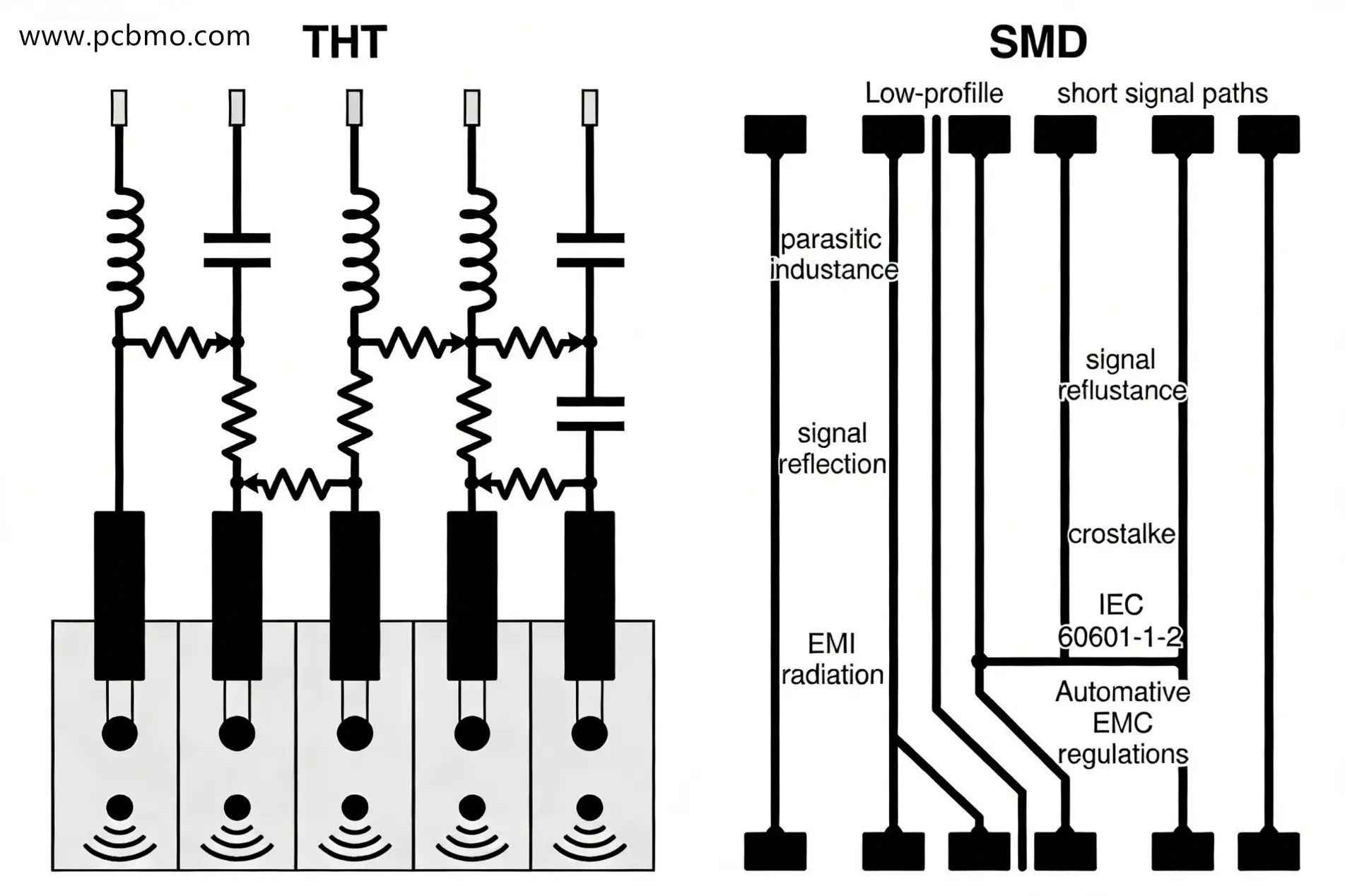
As electronic systems move toward higher frequencies (e.g., 5G, IoT, and high-speed computing), signal integrity (SI) and electromagnetic interference (EMI) become paramount—areas where THT design falls short. THT pins act as extended transmission lines, increasing signal path length and introducing parasitic inductance and capacitance. These parasitic effects cause signal reflections, crosstalk, and delay, degrading SI in high-frequency circuits.
The drilled holes for THT pins also disrupt the continuous reference planes (power and ground layers) essential for controlling EMI. This disruption creates antenna-like structures that radiate electromagnetic noise, violating EMC standards such as IEC 60601-1-2 for medical devices and automotive EMC regulations. SMD components, with their low-profile, short signal paths and compatibility with continuous reference planes, offer superior SI and EMI performance for high-frequency designs.
Component Availability and Industry Trend Misalignment
The electronics industry’s shift toward SMT has led to a gradual decline in THT component availability. Many semiconductor manufacturers prioritize SMD packaging for new products, limiting the range of THT options for designers. This trend is particularly evident in advanced ICs (e.g., microcontrollers, RF chips), where THT variants are either obsolete or available only in low volumes, increasing procurement costs and supply chain risks.
Furthermore, THT conflicts with emerging design paradigms such as System-in-Package (SiP) and 3D IC stacking, which rely on ultra-compact, high-density integration. These technologies leverage SMD’s miniaturization capabilities to achieve performance gains, leaving THT confined to niche applications like high-power relays and legacy equipment maintenance.
THT vs. SMT: Comparative Advantages and Disadvantages
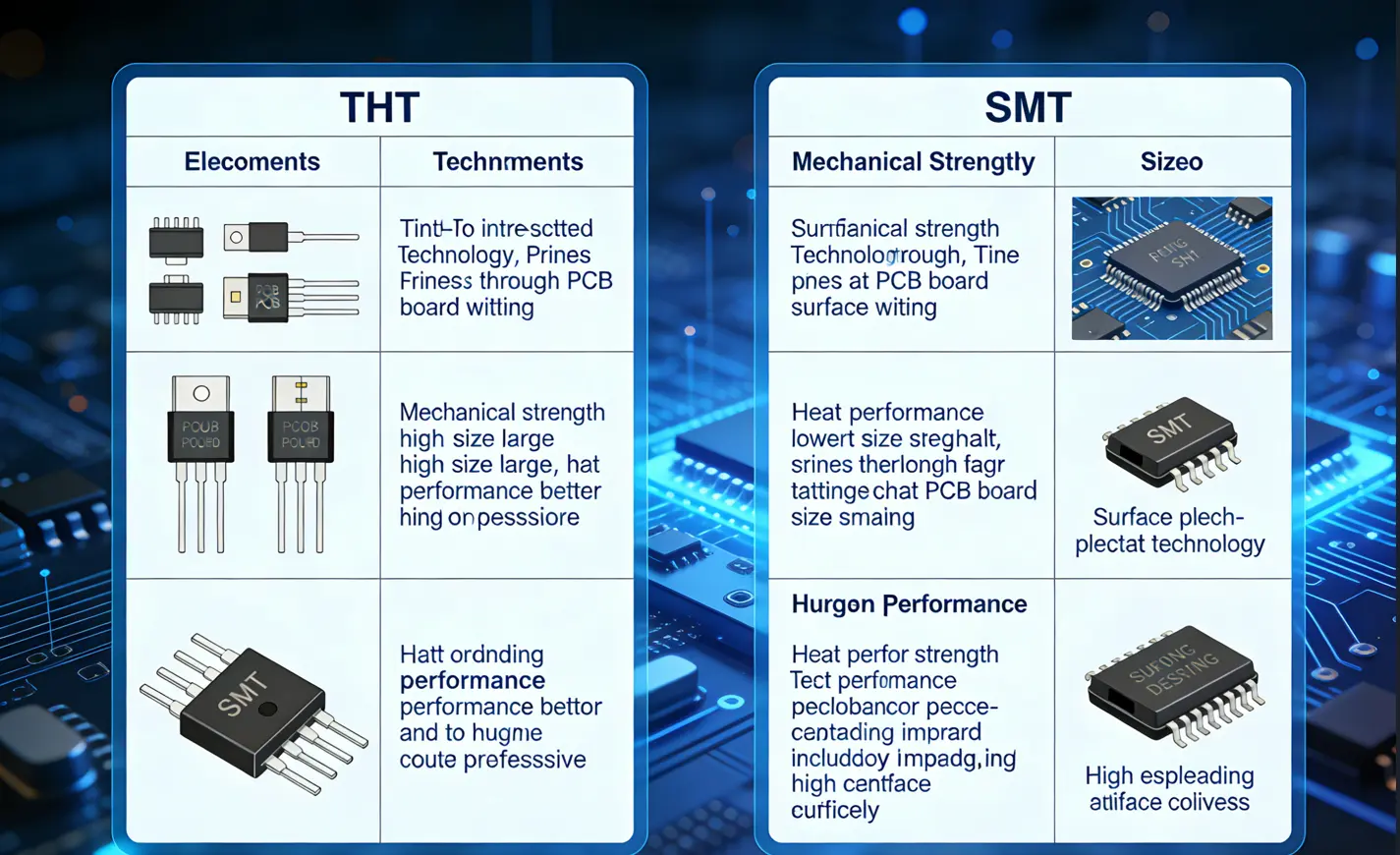
Understanding the strengths and weaknesses of THT and SMT is critical for balancing design requirements. THT’s primary advantages include exceptional mechanical stability—its through-hole pins create robust connections resistant to vibration and mechanical stress, making it ideal for harsh environments. It also offers superior thermal conductivity for high-power components, as pins facilitate direct heat transfer to the PCB’s inner layers. Additionally, THT components are easier to repair and rework, a key benefit for prototype development and legacy equipment maintenance.
However, THT’s drawbacks extend beyond the challenges noted earlier: it has higher material and assembly costs, larger PCB footprint requirements, and poor compatibility with high-frequency designs. SMT, by contrast, excels in miniaturization and high-density layouts, with smaller footprints and support for sub-millimeter component pitches. It enables automated, high-volume production with lower labor costs and better signal integrity for high-frequency applications. SMT’s limitations include weaker mechanical resilience (especially under vibration), more complex rework processes, and reliance on proper solder paste application and reflow profiling to avoid defects like cold joints.
Strategies to Reduce THT Usage in Modern PCB Design
Designers can adopt targeted strategies to minimize THT integration while preserving functionality. First, prioritize SMT equivalents for THT components—most passives (resistors, capacitors), semiconductors, and connectors have SMT alternatives that match or exceed performance. For high-power applications, use SMT packages with exposed thermal pads (e.g., D2PAK, QFN) or thermal vias to replicate THT’s heat dissipation capabilities without the through-hole requirement.
Second, optimize mixed-assembly workflows if THT is unavoidable. Place THT components on a single side of the PCB to streamline wave soldering and reduce thermal impact on SMT parts. Use automated THT insertion machines instead of manual labor to improve efficiency and reduce defects. Third, leverage alternative technologies like Press-Fit connectors, which eliminate soldering while maintaining mechanical robustness, or surface-mount power modules that combine high-power performance with SMT compatibility.
Finally, adopt modular design principles—confine THT components to dedicated sub-modules for legacy compatibility or high-power needs, while using SMT for the core compact circuitry. This approach isolates THT’s limitations and simplifies overall assembly.
Niche Applications Where THT Remains Advantageous
Despite its limitations, THT retains irreplaceable value in specific sectors. High-power electronics—such as industrial power supplies, motor controllers, and welding equipment—benefit from THT’s superior thermal conductivity and mechanical stability, as these systems operate under high current loads and require robust connections. Aerospace and defense applications also rely on THT for its resistance to extreme vibration, temperature fluctuations, and radiation, where component failure could have catastrophic consequences.
Legacy equipment maintenance and retrofitting is another key area—many older systems (e.g., industrial control panels, vintage test equipment) are designed for THT components, and replacing them with SMT would require extensive PCB redesign. THT is also preferred for prototype development and low-volume production, where its ease of rework reduces iteration time and costs. Additionally, high-voltage applications (e.g., power distribution systems) use THT for its ability to handle higher voltage isolation between pins, a feature harder to achieve with compact SMT packages.
In conclusion, while THT retains value in specific high-power, harsh-environment, and legacy applications, its inherent limitations in density, automation, thermal management, and signal integrity make it increasingly incompatible with modern electronic design requirements. By understanding THT and SMT’s comparative strengths, implementing strategies to reduce THT usage, and leveraging its niche advantages, designers can create balanced, high-performance PCB designs aligned with industry trends.