Technical Overview of Manufacturing Specifications for LED PCB Assemblies
In the rapidly advancing field of LED lighting, the performance, longevity, and reliability of a fixture are fundamentally determined by the quality of its Printed Circuit Board Assembly (PCBA). A well-engineered PCB is the backbone of any efficient lighting system. This article details the standard manufacturing specifications for a robust LED PCBA designed for high-performance applications.
Core Construction and Material Selection
The foundation of a reliable LED PCBA begins with its construction. Our standard assemblies are offered in both single and double-layer (1-2 layer) configurations, providing flexibility for a range of circuit complexities from simple indicator lights to more sophisticated driver boards.
A critical differentiator is the choice of substrate material, which directly impacts thermal management:
FR-4 Epoxy: A cost-effective and reliable standard for low to medium-power applications where heat generation is manageable.
Aluminum Substrate: The preferred choice for most high-power LED assemblies. Aluminum Core PCBs (MCPCBs) offer exceptional thermal conductivity, drawing heat away from the LED junctions to maintain optimal operating temperatures and significantly extend lifespan.
Copper Core: For the most demanding, high-power-density applications, copper substrates provide superior thermal conductivity, offering the ultimate solution for thermal dissipation.
Surface Finishes and Solder Mask
To ensure solderability and long-term reliability, boards are finished with a Lead-Free Hot Air Solder Leveling (HASL) or an Organic Solderability Preservative (OSP). The HASL lead-free finish provides a robust, shelf-stable surface, while OSP offers a flatter, more planar surface ideal for fine-pitch components.
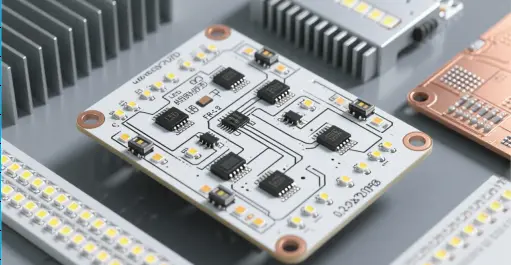
The solder resist is typically specified in white for LED lighting applications. A white solder mask maximizes the reflectivity of the board, enhancing light output efficiency and overall luminaire performance. Component designators and logos are clearly marked with a black silkscreen for high contrast and easy assembly.
Copper Thickness and Electrical Performance
The finished copper thickness is customizable from 0.5 oz to 2.0 oz, allowing designers to tailor the board to specific current-carrying requirements. Thicker copper traces reduce electrical resistance and minimize heat generation within the board itself, contributing to greater overall system efficiency.
Comprehensive Quality Assurance
Quality is verified at multiple stages. Every bare board undergoes electrical testing (PCB Testing) to isolate manufacturing defects like shorts or opens. Following the component assembly process, a full PCBA Testing procedure is conducted. This in-circuit testing validates the assembly integrity, ensuring every resistor, capacitor, and LED is correctly placed and functionally sound.
Primary Application: LED Lighting Assembly
These specifications are meticulously designed for the PCB LED lighting assembly market. This includes a wide array of applications such as architectural lighting, high-bay industrial fixtures, commercial downlights, street lighting, and horticultural grow lights. By selecting the appropriate combination of layer count, substrate material, and copper weight, manufacturers can develop lighting solutions that are efficient, reliable, and built to last.
In conclusion, understanding these fundamental PCB specifications is crucial for anyone involved in the design and manufacturing of modern LED lighting products. The right choices at the board level directly translate to superior end-product performance.
Product Designation: Light LED PCBA (Printed Circuit Board Assembly)
PCB Construction: Configurable as 1 or 2-layer board.
Base Material Options: FR-4 Epoxy, Aluminum Substrate, or Copper Core (IMS).
Surface Finish: Lead-Free Hot Air Solder Leveling (HASL) or Organic Solderability Preservative (OSP).
Solder Mask: White.
Copper Weight (Finished): Ranging from 0.5 oz to 2.0 oz.
Legend/Silkscreen: Black.
Quality Assurance: Includes bare board (PCB) testing and in-circuit (PCBA) testing.
Primary Application: Specifically designed for LED lighting solutions and assemblies.