Technical Overview of Rigid-Flex PCBA Design and Manufacturing Specifications
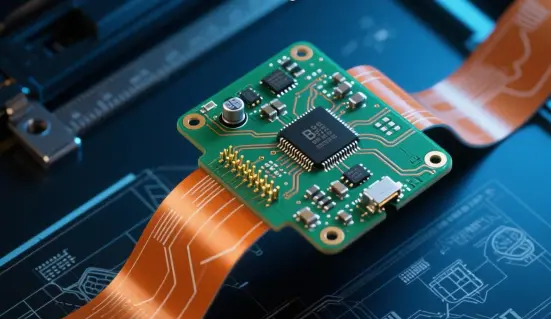
Rigid-Flex PCB Assembly (PCBA) represents a critical advancement in electronic interconnect solutions, merging the durability of rigid boards with the dynamic flexibility of circuits. This hybrid construction is essential for modern applications where space, weight, and reliability are paramount. The following technical data sheet outlines the key manufacturing specifications for a standard high-performance Rigid-Flex PCBA.
Core Material Construction
The foundation of a reliable Rigid-Flex board lies in its base materials. The substrate specified is a woven glass fiber cloth, which provides exceptional dimensional stability and mechanical strength. This is impregnated with a high-performance polyimide (PI) resin system. Polyimide is the insulating resin of choice due to its superior thermal endurance, excellent chemical resistance, and formidable dielectric properties, making it ideal for the thermal stresses of assembly and harsh operating environments.
Dimensional and Layer Specifications
Precise control over physical dimensions is critical for both fit and function.
Product Thickness: The design clearly differentiates between flexible and rigid sections. The flexible layer is manufactured to an ultra-thin profile of 0.15mm, enabling repeated bending. The rigid board segments are built to a thickness of 0.50mm, maintained within a tight tolerance of ±0.03mm to ensure compatibility with connectors and housings.
Board Size: The single-chip size is fully customizable based on the customer's provided drawings, offering design flexibility for various product form factors.
Conductor Details: The circuit traces are formed from an 18μm (0.5 oz) Electro-Deposited (ED) copper foil. This thickness offers a balance between current-carrying capacity and fine-line etch capability for detailed circuitry.
Surface Finishes and Solder Mask Options
The final finishes protect the circuitry and ensure solderability.
Solder Mask: Manufacturers offer multiple options, including photoimageable films in green, yellow, black, or white, as well as Liquid Photoimageable (LPI) solder mask for superior coverage and insulation.
Surface Finish: The board employs an Organic Solderability Preservative (OSP) coating with a thickness range of 12μm to 36μm. OSP is a popular, cost-effective finish that provides a flat surface for component placement and protects the copper pads from oxidation before soldering.
Reliability and Compliance Standards
To guarantee performance under demanding conditions, the Rigid-Flex PCBA adheres to stringent industry standards.
Fire Rating: The material set complies with the UL 94 V-0 flammability standard, indicating its self-extinguishing properties and enhancing the end-product's safety.
Thermal Reliability: A critical measure of quality is the thermal shock resistance. The assembly is tested to withstand solder heat resistance at 288°C for 10 seconds, simulating the conditions of a typical reflow soldering process and ensuring the integrity of the plated through-holes and materials.
This set of specifications defines a robust framework for producing high-quality Rigid-Flex PCBAs. By leveraging a polyimide-based glass fiber substrate, precise thickness control, and OSP finishing, this design is well-suited for applications requiring durability, miniaturization, and proven reliability in challenging thermal environments.
Base Material: Woven Glass Fiber Substrate
Dielectric Insulation: High-Temperature Polyimide (PI) Resin
Layer Thickness Specification: Flexible Layer: 0.15 mm
Rigid Board Segment: 0.50 mm (±0.03 mm tolerance)
Board Dimensions: Customer-Defined Single-Chip Size
Conductor Foil: 18 μm (0.5 oz) ED Copper
Solder Mask Options: LPI (Green) or Photoimageable Film (Yellow, Black, White)
Surface Finish: Organic Solderability Preservative (OSP), 12-36 μm
Flammability Rating: UL 94 V-0
Thermal Reliability: Solder Heat Resistance Test @ 288°C for 10 seconds